
RECENT SEARCHES
Recently Viewed
 Things you should know
2. The Mat Task: Scraping, wiping, or both?
3. The Entrance: Where do I put my mat, indoors or outdoors?
4. The Industrial Mat: For kitchens, factories, garages, and more.
5. Anti-fatigue: Mats that SAVE you money.
6. Custom Art Mats: Some stuff to know about design
1. The Mat Backing
Flat or Gripper backing keeps your mat in place. It’s one of the most important features of your mat, and no one will even see it. These two styles are available in two different materials: SBR and Nitrile Rubber.
Backing Style: Flat vs. Gripper:
Flat Back Best for hard, flat surfaces where there’s heavy traffic. Specially designed to prevent sliding. Gripper Back
 For hard surfaces with low traffic, or for commercial carpet, especially if it has 100% Loop or Cut/Loop pile.
Some mats may also require a carpet underlay. For Flat backing, we recommend our Magna Hold underlay, and for Gripper backing, our Magna Grip underlay.
Backing Materials - SBR vs. Nitrile:
Our rubber materials are naturally anti-microbial.
SBR is a synthetic rubber that reduces scratches and wear. It’s the more affordable option, and the most popular. It works best between -29°F to 170°F, for both cold and warm areas. But, it offers little resistance to oils, chemicals, sunlight, and heat. After exposure, SBR is inferior to Nitrile rubber.
Nitrile rubber (NBR) is also synthetic, and best for industrial mats. It resists heat, petroleum, mineral or vegetable oils, and many acids. A little pricier than SBR, we don’t recommend Nitrile unless you need oil resistance or heat protection. See the resistance list for Nitrile rubbers for more information.
2. The Mat Task: Scraping, wiping, or both?
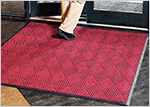
Scraper mats remove dirt and soil from footwear, and work great outside of stores or in factories. The coarse surface can hold moisture, or allow it to drain away from your entrance.
Wiper mats are finishers. They are less coarse than scraper mats and trap dust and water, so they don’t damage your floors. These are an important part of protecting your inside from the outside.
3. The Industrial Mat: For kitchens, factories, garages, and more.
To get the best performance out of your mat, you need to decide where you want to put it. Entrance areas, especially high traffic ones, need an indoor wiper and an outdoor scraper mat.
For low traffic areas, you can use just an indoor wiper mat. If your entrance isn’t covered, then choose an outdoor mat so water will flow through and away from the entrance area. Non-flow mats (typically with a border to trap moisture), can fill up quickly on a rainy day and lower the performance of your mats.
4. The Industrial Mat: Kitchens, Factories, Garages and more.
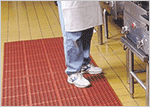
Industrial mats provide extra comfort for your employees, and with added benefits: slip-resistance, and dirt and moisture management.
Here’s what you need to know when choosing an industrial mat.
• For a rainy or wet area, get a flow-through mat for slip-resistance and drainage.
• Around oils, greases, or high temperatures, make sure the mat backing or construction uses Nitrile rubber, found in most of our industrial mats.
• For carpeting, get gripper backing. If it’s cut pile, we recommend the Magna Grip underlay.
5. Anti-fatigue: Mats that SAVE you money.
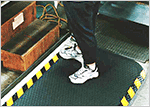
Every employer wants productive workers, without sacrificing their safety. Lost time from back strain, foot stress, general fatigue, and slip and fall accidents, cost over $6 billion in lost productivity in the US alone. Discomfort is distracting, especially if your workers spend their days on tough surfaces like tile or concrete.
Steps to help you decide which anti-fatigue mats you need:
• See where your employees spend most of their time. If they’re in a single area, a standard-sized mat will do the trick. If they’re moving from one place to another, you may need a series of mats, or a rolled or linked mat system. These are easy maintain, and help you affordably cover large areas.
• Traction is important. If you’re not working around water or chemicals, use a standard anti-fatigue mat to prevent slips and falls. The more moisture there is, the more traction you need.
• In some industrial settings, chemicals and machinery can create a potentially hazardous environment. A selection of our mats have optional OSHA borders, for extra safety and protection.
6. Custom Art Mats: Some stuff to know about design
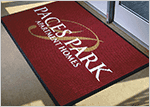
Custom artwork lets you show off your company’s brand, indoors or outdoors. We have a large selection of sizes and colors available. Keep in mind a few guidelines when uploading your artwork:
• You can upload two versions of your logo, a low resolution image for on-screen viewing and a high resolution file (like EPS or a file like Adobe Illustrator or CorelDraw) for production.
• Use EPS, TIF, JPG, BMP formats of your artwork or native program files for the high-resolution version. We prefer EPS or vector artwork files.
• If a proof is needed, we’ll return it within 48 hours of your artwork submission.
• You can tell us more information about your mat in the special instructions area. It’ll speed up the process.
• Use a valid email address, so we can quickly send information about the proof or order status.
Still have questions on submitting your artwork? Email us.
7. Custom Artwork Mats: Printing vs. Inlaying
We have two printing processes for custom mats: printing and inlaying. Our unique printing production includes a special dyeing process for quick turnaround times (less than 4 days for small quantities) and fantastic color and stain resistance with Perma-Dye and Stain Stopper.
The inlay process cuts our solution dyed materials so they fit together like a puzzle, so we can create a custom design just for you.
8. Cleaning your mats: It's this easy.
You can clean all of them with a hose, but you may want something a bit simpler. From a dry vacuum or a wet/dry cleaner to bleach, there are a variety of options to maintain your mats. Check out the cleaning chart to see all of your options.